
The KASRS Assistant Professor recruitment 2026 is a valuable opening for Sanskrit scholars who want a regular college teaching job in Kerala. The Kerala Ayurvedic Studies and Research Society (KASRS), Kottakkal, has invited applications for the post of Assistant Professor in Sanskrit at Vaidyaratnam P.S. Varier Ayurveda College, Kottakkal. Applications are handled through the Centre for Management Development (CMD), Thiruvananthapuram.
Online applications open on 4 November 2026 and close on 3 December 2026 at 5:00 PM. In this guide, we explain the KASRS Assistant Professor eligibility, pay, fee, selection process and the five easy steps to apply, along with tips to prepare a strong application.
KASRS Assistant Professor 2026: Quick Overview
Here is a short summary of the KASRS Assistant Professor notification. Always confirm details in the official notification on the CMD website before applying.
| Item | Details |
|---|---|
| Organisation | Kerala Ayurvedic Studies and Research Society (KASRS), Kottakkal |
| College | Vaidyaratnam P.S. Varier Ayurveda College, Kottakkal |
| Post | Assistant Professor in Sanskrit |
| Category No. | 801/2026 |
| Notification No. | TS/KASRS/002/2026 |
| Vacancy | 1 (Open Competition, regular basis) |
| Pay | As per UGC norms |
| Application fee | ₹3,000 (General), ₹1,000 (SC/ST/PH), plus transaction charges |
| Apply online | 4 November 2026 (10:00 AM) to 3 December 2026 (5:00 PM) |
| Website | cmd.kerala.gov.in |
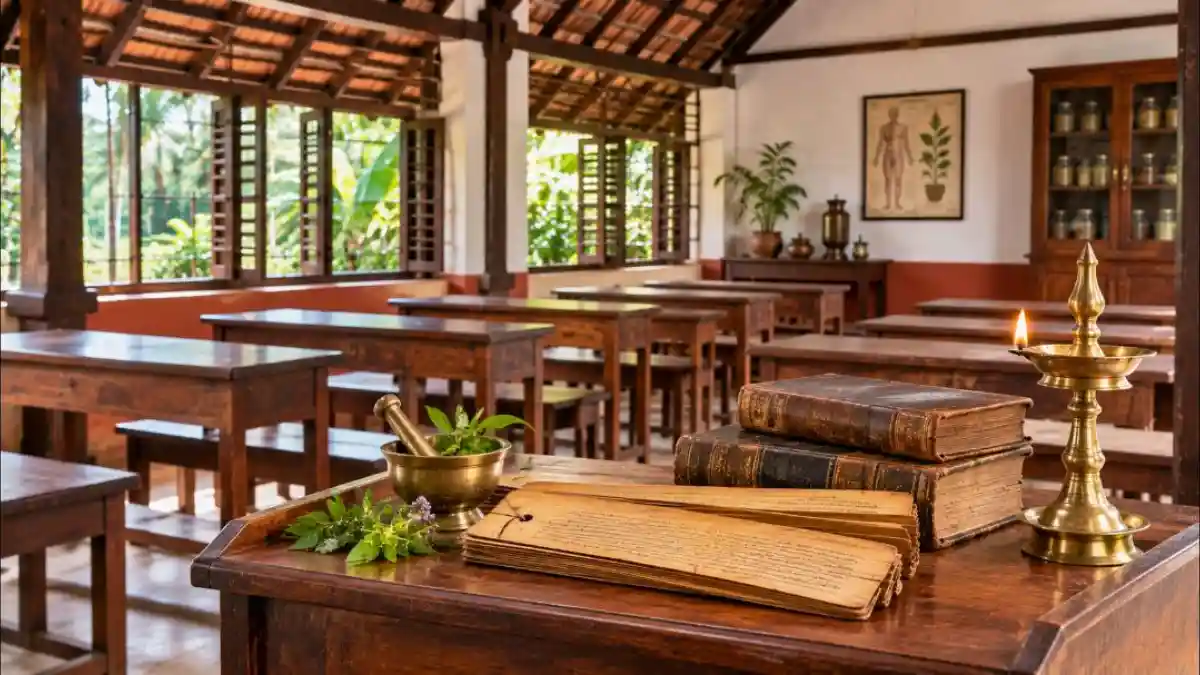
About KASRS and the Ayurveda College
The Kerala Ayurvedic Studies and Research Society runs Vaidyaratnam P.S. Varier Ayurveda College in Kottakkal, Malappuram district. Kottakkal is one of the best-known centres of Ayurveda in India, and the college is part of that long tradition of Ayurvedic education and practice.
Sanskrit has a special place in Ayurveda education. The classical texts of Ayurveda, such as the major Samhitas, are written in Sanskrit. Students of the BAMS course study Sanskrit so that they can read, understand and interpret these texts correctly. This is why the KASRS Assistant Professor in Sanskrit is an important academic post in the college.
Why Sanskrit Matters in Ayurveda Education
Ayurveda’s foundational knowledge was recorded in Sanskrit over many centuries. Terms for body systems, diseases, herbs, preparations and treatment methods all come from Sanskrit. Without a good grasp of the language, students may depend only on translations, which can miss subtle meanings.
A skilled KASRS Assistant Professor helps students move from basic reading to confident understanding of verses. This includes grammar, metre, word formation and the special vocabulary used in medical texts. Good Sanskrit teaching therefore supports better learning across the entire BAMS course.
For a Sanskrit scholar, teaching in an Ayurveda college is also intellectually rewarding. You see how a classical language connects directly with a living medical tradition that people still use today.
What Does a KASRS Assistant Professor in Sanskrit Do?
A KASRS Assistant Professor in Sanskrit teaches Sanskrit to Ayurveda students. The work usually includes teaching grammar, reading and translating classical passages, explaining technical terms used in Ayurvedic texts and helping students build confidence with the language.
Apart from classroom teaching, college faculty often guide students, set and evaluate exams, take part in academic committees, conduct seminars and work on research. A Sanskrit teacher in an Ayurveda college may also support colleagues in other departments when they need help with interpreting difficult textual passages.
The post is on a regular basis, which means it is a permanent teaching position, not a guest or contract job. For a qualified Sanskrit scholar, this is a stable and respected career option.
KASRS Assistant Professor Vacancy Details
| Post | Category No. | Vacancy | Type |
|---|---|---|---|
| Assistant Professor in Sanskrit | 801/2026 | 1 | Open Competition, regular |
There is only one vacancy, so competition will be strong. A well-prepared application with clear proof of qualifications and experience is essential.
KASRS Assistant Professor Eligibility
Educational Qualification
- A Master’s degree in Sanskrit with at least 55% marks. For SC, ST, OBC (non-creamy layer) and differently abled candidates, the minimum is 50%.
- NET or a PhD in the concerned subject.
- Five years of teaching experience in UGC-recognised colleges or universities.
Some third-party summaries list the qualification differently, so read the official KASRS Assistant Professor notification carefully to confirm every condition, including how experience is counted.
Age Limit
The notification summary gives the age limit as below 50 years, with candidates born on or after 02.01.1976 eligible. One summary table shows a slightly different figure, so check the official notification for the exact age rule and any relaxation.
| Criteria | Requirement |
|---|---|
| Degree | MA Sanskrit, 55% (50% for reserved and differently abled) |
| Eligibility test / research | NET or PhD |
| Experience | 5 years teaching in UGC-recognised institutions |
| Age | Below 50 years (born on or after 02.01.1976) |
KASRS Assistant Professor Salary
The pay for the KASRS Assistant Professor post is as per UGC norms. The notification does not give a fixed amount. Under UGC norms, Assistant Professors are placed in the academic pay level applicable to the post, with allowances as per the rules followed by the institution.
Since the exact figure is not stated, avoid relying on websites that quote a specific salary without a source. The offer letter will carry the final pay details.
KASRS Assistant Professor Application Fee
| Category | Fee |
|---|---|
| General | ₹3,000 |
| SC / ST / PH | ₹1,000 |
Transaction charges are extra, and the fee is non-refundable. Pay only through the official online payment option on the application page.
KASRS Assistant Professor Important Dates
| Event | Date |
|---|---|
| Online application opens | 4 November 2026, 10:00 AM |
| Last date to apply | 3 December 2026, 5:00 PM |
| Selection dates | To be informed to shortlisted candidates |
KASRS Assistant Professor Selection Process
CMD will decide the selection process. According to the notification summary, it may include one or more of the following stages.
- Screening of applications: Applications are checked for eligibility.
- Written test: A test on subject knowledge may be held.
- Group discussion: Candidates may be asked to discuss a topic in a group.
- Skill or proficiency test: This could include a teaching demonstration or language skill check.
- Interview: A personal interview with an expert panel.
Shortlisted candidates will be informed by email, SMS or phone, so keep your contact details active.

How to Apply for KASRS Assistant Professor: 5 Easy Steps
- Visit the CMD website: Go to the official CMD Kerala website and open the KASRS notification.
- Read the notification: Download and read the full notification for Category No. 801/2026.
- Fill the online form: Enter your personal, educational and experience details carefully.
- Upload documents: Upload a photograph (under 200 kB, JPG), signature (under 50 kB, JPG), and your educational and experience certificates.
- Pay and submit: Pay the fee online, submit before 5:00 PM on 3 December 2026 and save a copy of the submitted form.
For help, the notification lists a help desk number: 0471 2320101, available from 10 AM to 5 PM, Monday to Friday.
Documents Checklist
- MA Sanskrit certificate and mark lists
- NET certificate or PhD degree certificate
- Experience certificates from UGC-recognised colleges or universities
- SSLC certificate as proof of date of birth
- Community or non-creamy layer certificate, if applicable
- Disability certificate, if applicable
- Recent photograph and signature in the required size

How to Build a Strong Application
With only one KASRS Assistant Professor vacancy, the screening stage is very important. Your application should clearly show that you meet every condition and that you bring something extra to the post.
- Organise experience proof: Collect experience certificates that show the institution name, its UGC recognition, your designation, subject and exact dates of service.
- Highlight research: List your PhD topic, publications, conference papers and any projects related to Sanskrit or Ayurveda texts.
- Show teaching quality: Mention courses you have taught, new teaching methods you used and any awards or feedback.
- Keep it accurate: Make sure every date and mark in the form matches your certificates.
Preparing for the Written Test
If CMD conducts a written test for the KASRS Assistant Professor post, expect questions that test your depth in Sanskrit. Revise these broad areas.
Grammar (Vyakarana)
Revise sandhi, samasa, karaka, krit and taddhita formations, and verb forms. Ayurvedic verses use many compound words, so samasa analysis is especially useful.
Literature and Poetics
Go over major works of classical Sanskrit literature, chandas (metres) and alankara. Questions may ask you to identify metres or explain figures of speech in a verse.
Technical Vocabulary of Ayurveda
Learn common Sanskrit terms used in Ayurveda, such as those for doshas, dhatus and basic treatment concepts. You do not need to be an Ayurveda expert, but familiarity helps you teach BAMS students better.
Teaching Methods
Be ready for questions on how to teach Sanskrit to students who are not language specialists. Simple, step-by-step methods and practical examples are key.
Teaching Demonstration Tips
Many colleges ask candidates to give a short demo class. If the KASRS Assistant Professor selection includes a skill test or demonstration, prepare one or two topics thoroughly.
- Choose a topic that fits first-year BAMS students, such as basic sandhi rules with examples from Ayurvedic verses.
- Start with a clear objective and end with a quick summary.
- Use the board well, with neat writing and simple diagrams.
- Ask one or two questions to involve the audience.
- Keep within the time limit given by the panel.
A 4-Week Preparation Plan
Once you submit your KASRS Assistant Professor application, use the waiting time well. Here is a simple four-week plan that covers the likely stages of selection.
| Week | Focus |
|---|---|
| 1 | Vyakarana revision: sandhi, samasa, karaka and verb forms |
| 2 | Literature, chandas and alankara with practice verses |
| 3 | Ayurvedic Sanskrit vocabulary and reading of selected verses |
| 4 | Demo class practice, mock interviews and document check |
Understanding the Experience Condition
The five-year teaching experience rule is often the trickiest part of the KASRS Assistant Professor eligibility. The notification asks for experience in UGC-recognised colleges or universities. Before applying, confirm that each institution where you worked meets this condition.
Add up your service period carefully, using the exact joining and relieving dates on your certificates. If you worked part-time, as a guest lecturer or on contract, check the official notification to see how such experience is treated. When in doubt, contact the CMD help desk before the last date instead of guessing.
Keep salary certificates or appointment orders as additional proof, because verification panels sometimes ask for them.
Working at Kottakkal
Kottakkal in Malappuram district is a well-known centre for Ayurveda, with hospitals, research units and medicine manufacturing nearby. Working here as a KASRS Assistant Professor gives you a chance to be part of an active Ayurveda community.
The town is well connected by road to Kozhikode, Malappuram and Thrissur, and the nearest major airport is Kozhikode International Airport. Faculty members often find it a calm place to live while staying close to larger cities.
Research Opportunities in Sanskrit and Ayurveda
Many Ayurvedic texts and commentaries still need careful study, translation and critical editing. A Sanskrit faculty member at an Ayurveda college is well placed to take up such work. Projects on manuscripts, glossaries of Ayurvedic terms and easy learning materials for students can make a real contribution.
Research also strengthens your academic profile for future promotions. Publishing in recognised journals, presenting at seminars and collaborating with Ayurveda faculty are good ways for a KASRS Assistant Professor to build a strong research record over the years.
Sample Interview Questions
- Why do you want to teach Sanskrit in an Ayurveda college?
- How would you make Sanskrit grammar easy for BAMS students?
- Explain your PhD research in simple terms.
- How can Sanskrit teaching support research in Ayurveda?
- Describe a difficult teaching situation you handled and what you learned.
Career Growth for Assistant Professors
Under UGC norms, Assistant Professors can move to higher academic levels over time based on service, performance and the promotion rules followed by their institution. Research publications, completed projects, guidance of students and contribution to the college all help in career progression.
A KASRS Assistant Professor in Sanskrit can also grow as a researcher by working on manuscript studies, critical editions or translations of Ayurvedic texts. Such work adds value both to your career and to the field.
Who Should Apply?
This post suits experienced Sanskrit teachers who already have NET or a PhD and at least five years of teaching in UGC-recognised institutions. It is a good fit for those who want a regular post in Kerala and have an interest in the connection between Sanskrit and Ayurveda.
If you do not yet meet the experience or NET/PhD conditions, use this time to build them. Clearing NET and completing a PhD will open many more college teaching options in the future.
Selection Day Tips
- Carry original certificates and one set of self-attested copies arranged in order.
- Bring a printed copy of your submitted application and fee receipt.
- Dress formally and reach the venue well before the reporting time.
- For a demo class, carry chalk or markers and a short written plan.
- Answer interview questions honestly and keep answers focused.
Final Checklist Before Submitting
Before you submit your KASRS Assistant Professor application, read the notification once more from start to end. Check that your marks meet the 55% rule (or 50% for eligible categories), that your NET or PhD proof is attached, and that your five years of experience are clearly documented.
Make sure your photograph and signature meet the size limits, your email and phone number are correct, and the fee payment is successful. Save the final submitted form as a PDF and keep a printed copy. These simple checks can save you from rejection at the screening stage, which is especially important when there is only one vacancy.
Common Mistakes to Avoid
- Applying without the full five years of eligible teaching experience.
- Submitting experience certificates without clear dates or institution details.
- Uploading a photo or signature above the size limit.
- Missing the 5:00 PM deadline on 3 December 2026.
- Not checking email and phone after applying, and missing the shortlist call.
Frequently Asked Questions
What is the last date to apply for KASRS Assistant Professor 2026?
The last date is 3 December 2026 at 5:00 PM.
How many vacancies are there?
There is one vacancy for Assistant Professor in Sanskrit under Open Competition.
What is the qualification?
MA Sanskrit with 55% (50% for reserved and differently abled categories), NET or PhD, and five years of teaching experience in UGC-recognised institutions.
What is the application fee?
₹3,000 for General candidates and ₹1,000 for SC/ST/PH, plus transaction charges.
What is the salary?
Pay is as per UGC norms. The exact figure is not stated in the summary.
Where do I apply?
Online through the CMD Kerala website, cmd.kerala.gov.in.
Is the KASRS Assistant Professor post permanent?
Yes. The notification describes it as a regular post under Open Competition.
Who conducts the selection?
CMD Kerala manages the recruitment and decides the selection process for KASRS.
Tips for Younger Sanskrit Scholars
If you are still a student or early in your career, this notification shows what colleges expect from a teacher. Score well in your MA, clear NET, start a PhD in an area you love and gain steady teaching experience in recognised institutions. Publish small research papers and attend seminars to build your profile. In a few years, you will be ready for posts like this one and for many other college teaching openings in Kerala and across India.
Conclusion
The KASRS Assistant Professor recruitment 2026 offers a regular Sanskrit teaching post at a respected Ayurveda college in Kottakkal. With just one vacancy and strict eligibility, careful preparation of your application and documents is key.
Apply before 3 December 2026 and prepare well for every possible stage of selection. If you are still building your eligibility, read our guides on UGC NET December 2026 and Kerala SET January 2027.